Lesson 1
CLASS 10 ICSE
BIOLOGY
CHAPTER 1 – Cell Structure
Introduction to Cell
- The cell is the basic structural and functional unit of life.
- Discovered by Robert Hooke in 1665 using a compound microscope.
- Cell theory (by Schleiden and Schwann):
- All living organisms are composed of cells.
- The cell is the basic unit of life.
- All cells arise from pre-existing cells (added by Rudolf Virchow).
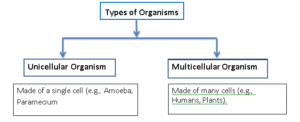
Types of Organisms
Types of Cells
- Prokaryotic Cells: No true nucleus or membrane-bound organelles. (e.g., Bacteria)
- Eukaryotic Cells: Have a true nucleus and membrane-bound organelles. (e.g., Plant and Animal cells)
Differences Between Plant and Animal Cells
| Feature | Plant Cell | Animal Cell |
| Cell wall | Present (cellulose) | Absent |
| Shape | Fixed, rectangular | Irregular or round |
| Vacuoles | Large central vacuole | Small, temporary vacuoles |
| Plastids | Present (chloroplasts, etc.) | Absent |
| Centrosome | Absent | Present with centrioles |
Structure of a Generalized Cell
A. Cell Membrane (Plasma Membrane)
- Semi-permeable membrane made of lipids and proteins.
- Controls movement of substances in and out of the cell.
- Provides shape and protection.
B. Cytoplasm
- Jelly-like fluid inside the cell membrane.
- Site for many metabolic activities.
- Contains cell organelles.
Cell Organelles and Their Functions
| Organelle | Structure & Function |
| Nucleus | Contains chromatin (DNA), nucleolus (makes RNA), and is surrounded by the nuclear membrane. Controls cell activities and is the site of inheritance. |
| Mitochondria | Known as the powerhouse of the cell. Performs aerobic respiration to produce energy (ATP). Has inner folds called cristae. |
| Endoplasmic Reticulum (ER) | Rough ER has ribosomes; helps in protein synthesis. Smooth ER helps in lipid synthesis and detoxification. |
| Ribosomes | Small, non-membrane-bound organelles. Site of protein synthesis. |
| Golgi Apparatus | Modifies, packages, and transports proteins. Produces secretory vesicles and forms lysosomes. |
| Lysosomes | Contains digestive enzymes. Breaks down worn-out organelles or foreign substances (suicide bags). |
| Plastids | Found in plant cells. Includes chloroplasts (photosynthesis), chromoplasts (coloured pigments), leucoplasts (storage). |
| Vacuoles | Storage sacs. In plants, large central vacuole maintains turgor pressure. |
| Centrosome | Found in animal cells. Helps in cell division. Contains centrioles. |
Chromosomes
- Thread-like structures in the nucleus.
- Made of DNA and proteins.
- Carry genetic information.
- Appear during cell division.
Functions of the Cell
- Metabolism: Sum of all chemical reactions.
- Anabolism: Building up (e.g., protein synthesis).
- Catabolism: Breaking down (e.g., respiration).
- Growth: Increase in size and number of cells.
- Reproduction: Formation of new cells or organisms.
- Response to stimuli: Sensitivity to environmental changes.
Comparison Between Prokaryotic and Eukaryotic Cells
| Feature | Prokaryotic Cell | Eukaryotic Cell |
| Nucleus | No true nucleus | True nucleus |
| Membrane-bound organelles | Absent | Present |
| Example | Bacteria | Plants, Animals |